




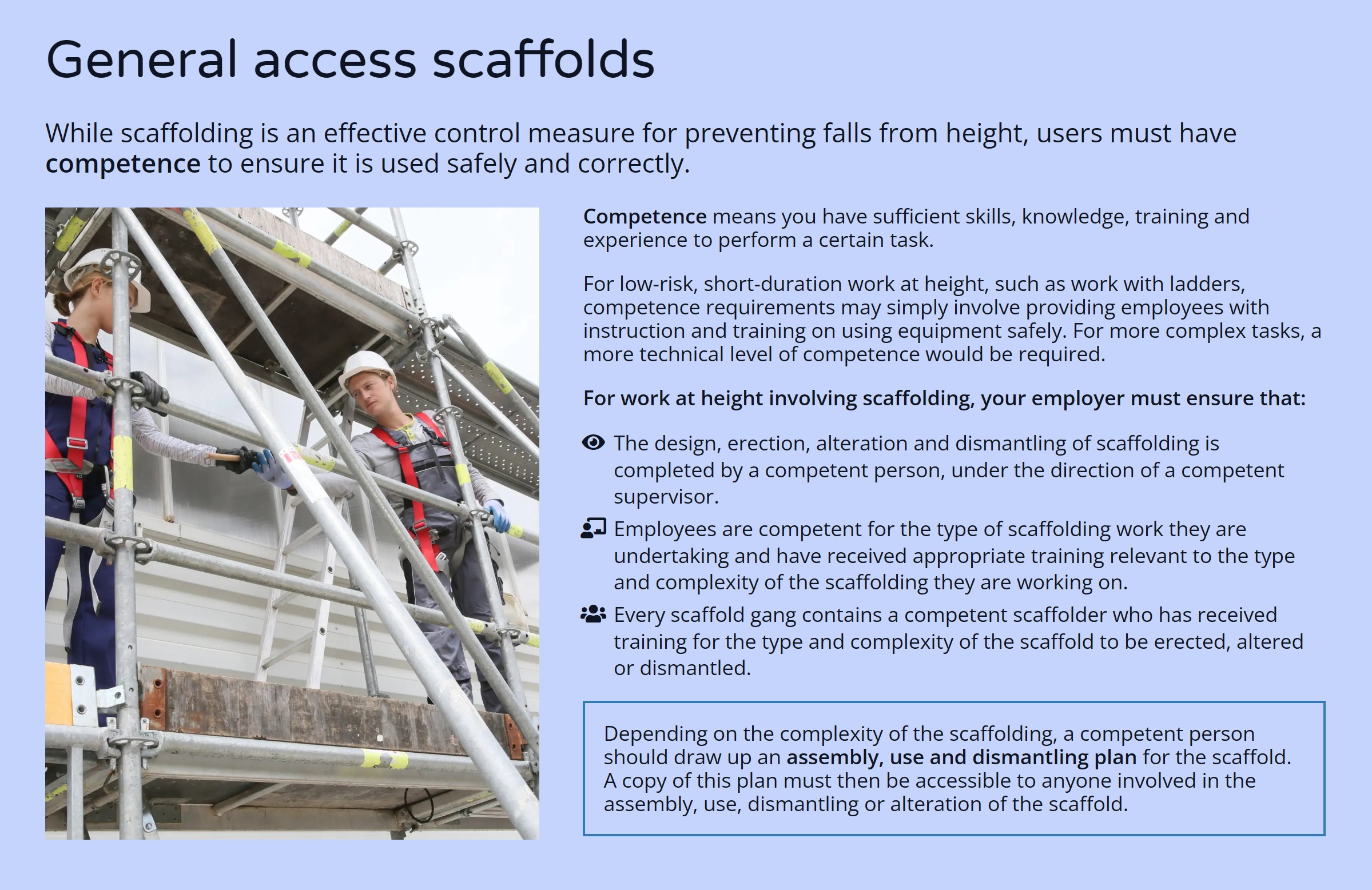
In Food Production, Ladders are a common way to work at height - and a common source of falls when they are misused. This guide explains how Food Production teams in Ireland use Ladders safely, and why a Working at Heights Course ties it all together.
Ladders in Food Production: where the risk lies
A food plant's overnight sanitation and maintenance window, when crews access overhead services above freshly cleaned, slippery floors. Ladders are suited to short-duration, light work where three points of contact can be kept and a better platform is not justified, but in a Food Production setting the margin for error is small.
Pre-use checks for Ladders
Before any Food Production worker uses Ladders, confirm that:
- Rungs are secure, clean and not worn
- No makeshift repairs, paint hiding cracks, or missing parts
- Locking mechanisms and stays work fully
- Feet are present, intact and grip the surface
The relevant standard here is EN 131 (the current European standard for portable ladders; older Class 1 / EN 131 markings indicate industrial duty).
Common Ladders faults to never ignore
- Loose or damaged rungs
- Bent or split stiles
- Mud or grease on rungs reducing grip
- Worn or missing feet
Wet, hygienic environments add slip risk to height work, so anti-slip access and clear scheduling are essential.
The Working at Heights Course makes compliance simple
Here is the good news: getting compliant is fast and inexpensive. Our Working at Heights Course is delivered fully online, takes about 45 minutes, and issues a downloadable certificate the same day. It is CPD certified, RoSPA approved and QQI aligned, and it is written specifically for Food Production teams using Ladders.
The Working at Heights Training covers the avoid-prevent-minimise hierarchy, ladder and stepladder safety, MEWPs and scaffolds, harnesses and anchor points, and how to carry out a proper risk assessment. Every learner finishes with a recognised Working at Heights Certificate that stands up to HSA inspection and supports your insurance position.
Training that goes beyond the tick-box
Documentation is what turns good practice into proven compliance for Ladders in Food Production. Keep your risk assessment, your method statement, your equipment inspection logs and your training records together, and an HSA visit becomes a short, calm conversation rather than a drawn-out investigation.
Insurers now ask directly whether your team holds current Working at Heights certification before they price a policy or settle a claim involving Ladders in Food Production. A worker hurt at height with no Working at Heights Certificate turns a defensible incident into an indefensible one, and that follows your premium for years.
Frequently asked questions
Do Food Production workers need training to use Ladders?
Yes. Safe use of Ladders is part of working at height. A Working at Heights Course covers selection, inspection and safe use for Food Production tasks.
How often should Ladders be inspected?
Before every use by the operator, plus formal recorded inspections to the relevant standard. Keep the logs for HSA inspection.
Is online training enough for Food Production height work?
Our online Working at Heights Training covers the legal and safe-system knowledge; equipment-specific practical tickets (such as IPAF or PASMA) are added where the task requires them.
More on staying safe at height
Falls from height remain one of the leading causes of serious and fatal workplace injury in Ireland, year after year. The pattern is depressingly consistent for ladders in food production: a short task, a familiar setting, a ladder or platform that seemed fine, and a single moment of overreach. Proper training breaks that pattern by making the safe choice the automatic one.
Get certified today
Do not wait for an HSA inspection or a near miss to act. Food Production teams can complete the Working at Heights Course online in 45 minutes and download a certificate the same day. For 10 or more learners, see our team training rates, or contact our team for a tailored quote.
Start the online Working at Heights Training now and put a recognised certificate in every worker's file before the next job at height begins.