




For Agriculture and Farming employers and workers, this guide explains how to carry out and record a work-at-height risk assessment, and how a Working at Heights Course ties it to your day-to-day Agriculture and Farming work.
Risk Assessment in Agriculture and Farming
A farmer replacing storm-damaged roof sheeting on an exposed shed, often alone, with no one to raise the alarm after a fall. When it comes to how to carry out and record a work-at-height risk assessment, Agriculture and Farming teams have to control hazards such as falls from machinery and tankers, falls through fragile or aged roof sheeting and work on bale stacks and trailers. Agriculture has one of Ireland's worst fatal-fall records. Fragile-roof awareness and never working alone at height are the key messages.
The Agriculture and Farming action list
- Record a risk assessment for each Agriculture and Farming task at height
- Choose collective protection before personal protection
- Certify the team with a Working at Heights Course
- Inspect equipment and keep the logs
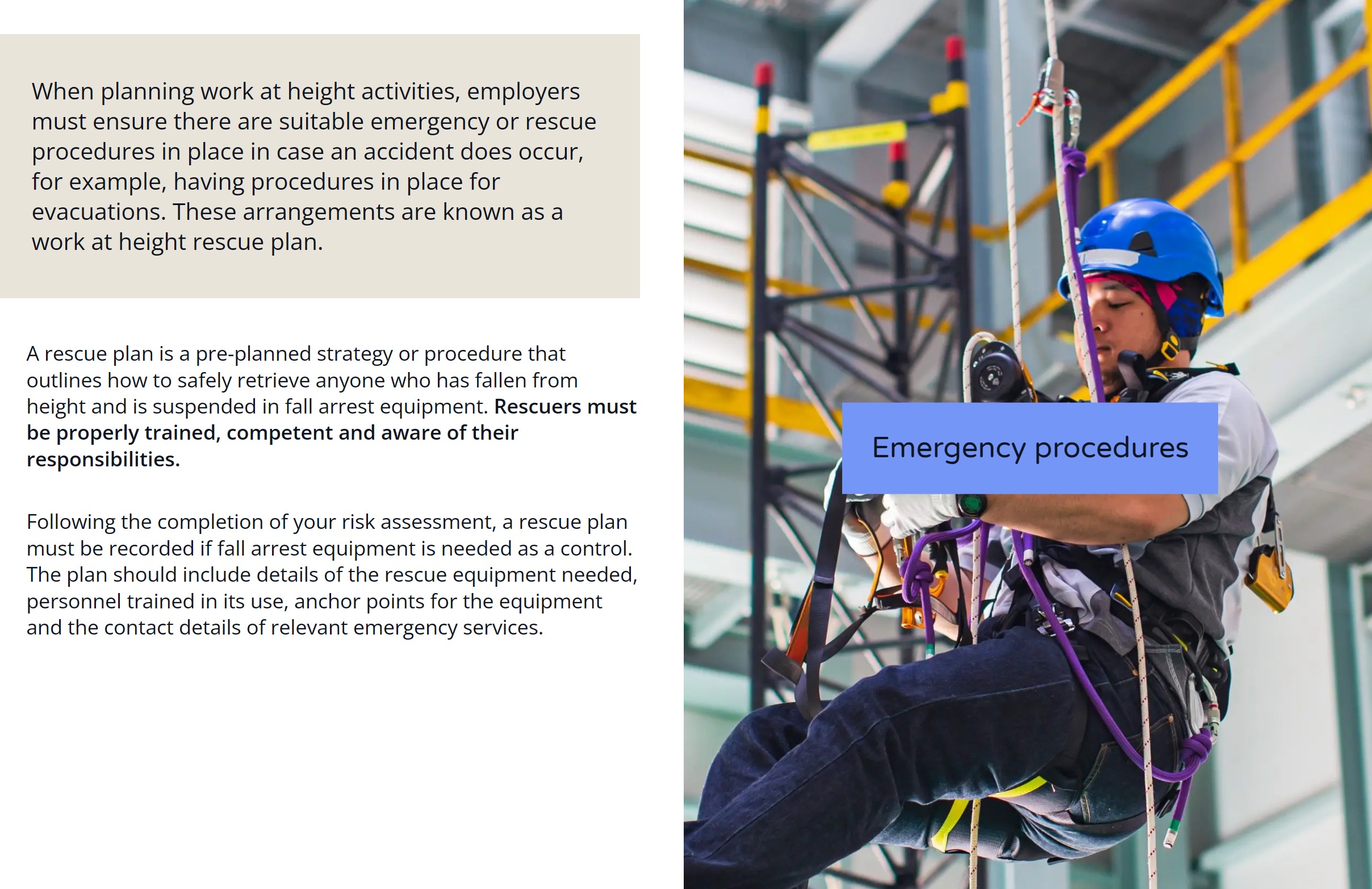
- Plan rescue before work begins
The Working at Heights Course makes compliance simple
You do not need a classroom or a lost work day to fix this. Our Working at Heights Course is delivered fully online, takes about 45 minutes, and issues a downloadable certificate the same day. It is CPD certified, RoSPA approved and QQI aligned, and it is written specifically for Agriculture and Farming teams across Ireland.
The Working at Heights Training covers the avoid-prevent-minimise hierarchy, ladder and stepladder safety, MEWPs and scaffolds, harnesses and anchor points, and how to carry out a proper risk assessment. Every learner finishes with a recognised Working at Heights Certificate that stands up to HSA inspection and supports your insurance position.
Training that goes beyond the tick-box
Young and new workers are over-represented in fall statistics, and Risk Assessment in Agriculture and Farming is no exception. Setting good habits from the very first day - never climbing on furniture, never overreaching, always inspecting equipment - is far easier than unlearning bad ones later. Early certification with a Working at Heights Course pays back for an entire career.
The cheapest control is always to avoid the work at height in the first place. For Risk Assessment in Agriculture and Farming, that can mean long-handled tools, lowering the task to ground level, or designing the job so no one needs to climb. Where that is impossible, collective protection such as guardrails and platforms beats personal protection every time.
Frequently asked questions
Do I need a risk assessment for working at height?
Yes. A written, task-specific risk assessment is a legal requirement before any work at height begins.
How does this affect Agriculture and Farming specifically?
In Agriculture and Farming, the same rules apply with sector-specific hazards. Our Working at Heights Training covers both.
Is online training enough for Agriculture and Farming?
Yes for the core legal and safe-system knowledge; add equipment-specific tickets where the Agriculture and Farming task requires them.
More on staying safe at height
Insurers now ask directly whether your team holds current Working at Heights certification before they price a policy or settle a claim involving agriculture and farming work at height. A worker hurt at height with no Working at Heights Certificate turns a defensible incident into an indefensible one, and that follows your premium for years.
Get certified today
Do not wait for an HSA inspection or a near miss to act. Agriculture and Farming employers and workers can complete the Working at Heights Course online in 45 minutes and download a certificate the same day. For 10 or more learners, see our team training rates, or contact our team for a tailored quote.
Start the online Working at Heights Training now and put a recognised certificate in every worker's file before the next job at height begins.